
A Burning Summer
And what buildings can do about it.
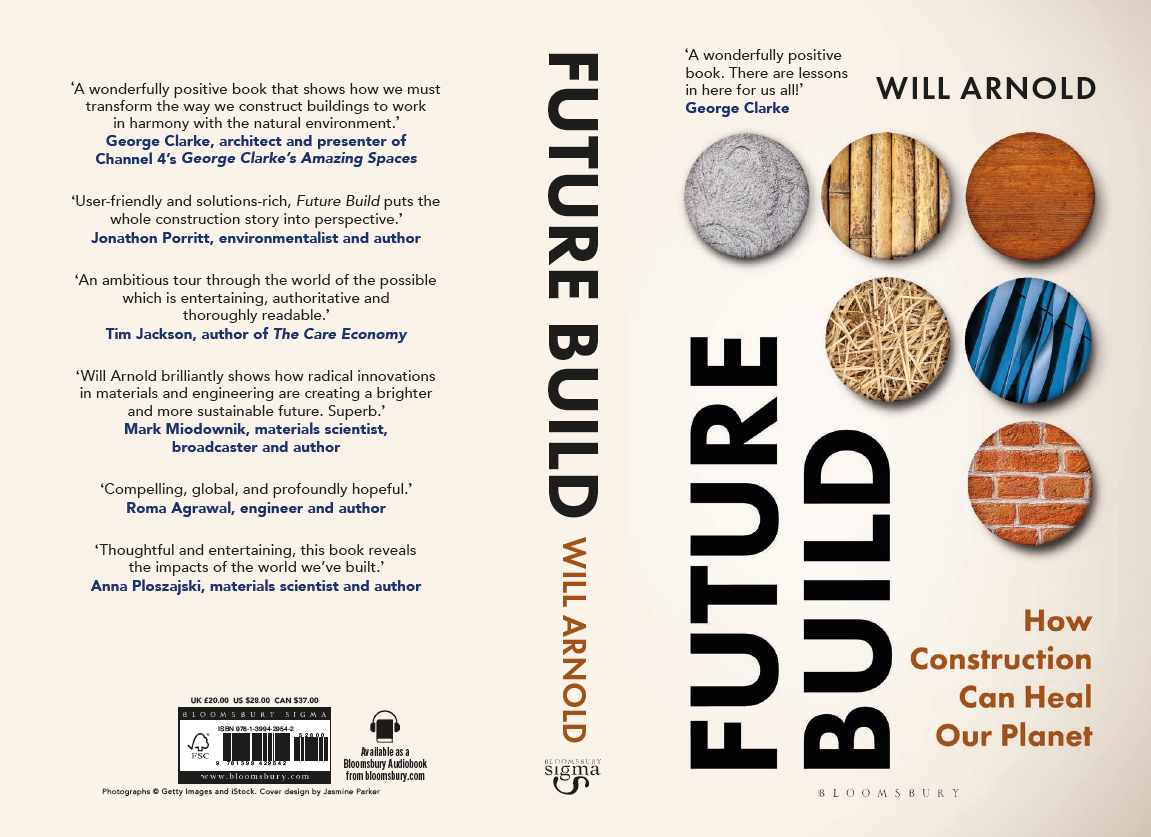
As we all bake in the heat this summer in the UK, and more broadly, we need to consider what part the construction industry plays in carbon emissions, waste, and the climate emergency more broadly. So it's timely that I got to chat to a friend, and fellow structural engineer Will Arnold about his new book, FUTURE BUILD. I often think about what we can do to make construction affect our environment less badly, but Will goes a step further and discusses how it can actually do overall good.
I hope you enjoy this interview, please leave a comment if you have any more questions! Will also shares his tips for keeping cool during a heatwave...
What is the premise of your new book?
Future Build tackles one of the most unknown tensions in today’s world – the environmental impacts of constructing buildings.
On the one hand, humanity cannot survive without buildings: almost everything we do involves them in some way, from the birth of a child in a hospital to the funeral of a friend in a church. Without buildings, life as we know it would not exist. And in many places, we need far, far more of them.
But the problem is that creating these buildings leaves a trail of ecological damage: the very materials with which we build from require us to burn fossil fuels, mine metals and rocks, and release pollution. This happens on an incomparable scale: adding up to a tenth of the world’s emissions, a third of all waste, and half of all global material extraction.
My book confronts these issues heads on, and asks how we can build in a way that still provides everything society needs – safety, shelter, joy and wonder – but also while healing the planet, rather than harming it.
2. Give me an example of how a building can heal its surroundings?
The Kendeda Building at the Georgia Institute of Technology in the USA is a good example of how construction can be a force for good, as they created so many parts of the building out of ‘waste’ created elsewhere in the city, that they actually diverted more materials from landfill than were sent to it. Their building was ‘waste-positive’. This included storm-felled oak trees for benches and counters, joists from a demolished church, and roofing slates that the Kendeda team repurposed as bathroom tiles.
The project has 28 stories of reuse like these, but my favourite relates to the 7km of waste timber collected from film sets that were nailed together to create floor panels. I’m told that work was undertaken by chronically unhoused people via a local non-profit, Georgia Works!, meaning that the project didn’t just help clean the city, it created jobs and training for people who needed them the most.
The work of Pakistan’s most famous architect, Yasmeen Lari, has had a similar impact. She has spent the last two decades overseeing the creation of more than 50,000 new homes in her country, working with local builders, and all using traditional building techniques and local materials. Her work has delivered extraordinary social returns for incredibly modest ecological investments.
3. How can building heal or benefit its inhabitants?
When me and my (now ex-)colleagues built the Rwanda Institute for Conservation Agriculture, we did so from local earth, stone and timber, creating something 60% lower-carbon than today’s typical university buildings (better still, tree-planting across the campus will have cancelled the remaining emissions out entirely by the 2030s.) This didn’t just slash our environmental impact, but created buildings that stay cool through the day without any air conditioning, despite Rwanda’s equatorial location.
Straw House – a home and office built by Sarah Wigglesworth and Jeremy Till at the turn of the millennium, in central London, backing onto a trainline – has similar benefits, with the straw walls allowing moisture to move naturally in and out of the building, preventing mould, keeping indoor air fresh, and reducing the build-up of pollutants. Stand outside in their garden, and you hear, feel, and smell the full force of London’s commuters coming and going. Step inside their straw bale cocoon, and the city fades to a whisper.
4. What are some ancient techniques that we are looking at resurrecting, and why?
For millennia, if you couldn’t grow it or dig it out the ground, you probably weren’t building with it. The impacts that I worry about today come from the fact that we’ve now converged onto industrial materials instead – created with levels of heat as hot as a space rocket – because of their durability and strength. But that doesn’t mean that our ancient, natural materials have gone away. I argue that today’s rule needs to be “right material, right place” – and Future Build shows how we can apply today’s engineering know-how to our old-school materials, to wondrous effect.
As an example, when engineers recently completed the world’s tallest church – the Sagrada Família, in Barcelona, Spain – they wanted to stay true to the original architect’s vision of stone spires that were only surpassed in height by God’s own work (a.k.a., a nearby hill). To do this in a way that was quicker and stronger than the typical ‘stack blocks on top of each other’ approach of stonemasonry, the engineers threaded thin stone panels onto steel rods, halving the weight of the towers, making them lower-carbon while actually being stronger than the traditional alternative.
5. Given we're all struggling with relentless heatwaves in Europe right now, how can we manage our homes to keep them as cool as possible?
Air conditioning! Of course, I’m joking. Interestingly, even if we do decide to put air-con into a building, we would be throwing money (and energy) away if we were to allow the sun’s heat to enter the building in the first place.
If you walk around any Mediterranean country in the summer mid-afternoon, you’ll see that everyone has shut their shutters, pulled down external blinds, and drawn out their extendable canopies as far as they possibly can. This isn’t just for show, they’re stopping the hot rays of the sun from ever hitting their windows. Once that heat is inside, it’s hard to remove. So they shut up shop at lunchtime, and wait for the outside temperature to cool down again before letting the breeze back in.
I do this in my London flat too now. It works wonders.