
Playing with glass
And more Women's Prize books
As the garden chairs come out, I was reminded of visiting the brilliant Samantha Sweet last Spring under the guise of book research. (It was definitely research...)
Please also join your hands together to wish me Happy Publication Day! How To Build a Chocolate Bridge is officially out!
I wanted to learn more about glass as a material, and in particular, why it's perfect as a vessel for conducting chemical experiments. From the time of the earliest alchemists, glass was a prized material with which they made tubes, bulbs, and alembics. Being an inert or non-reactive substance means that the glass didn't dissolve even when faced with strong acids. The surface of glass is extremely smooth, so minuscule particles of chemicals can’t burrow themselves and hide from the reaction, substances don’t easily stick to glass, which makes it an easy material to clean. And it's transparent, so alchemists could see what happened to the material when heated — when it started steaming or bubbling, how it changed colour (or not), when the components dissolved, and if it changed state from solid to liquid to gas — important data for the experimenters to observe and record.
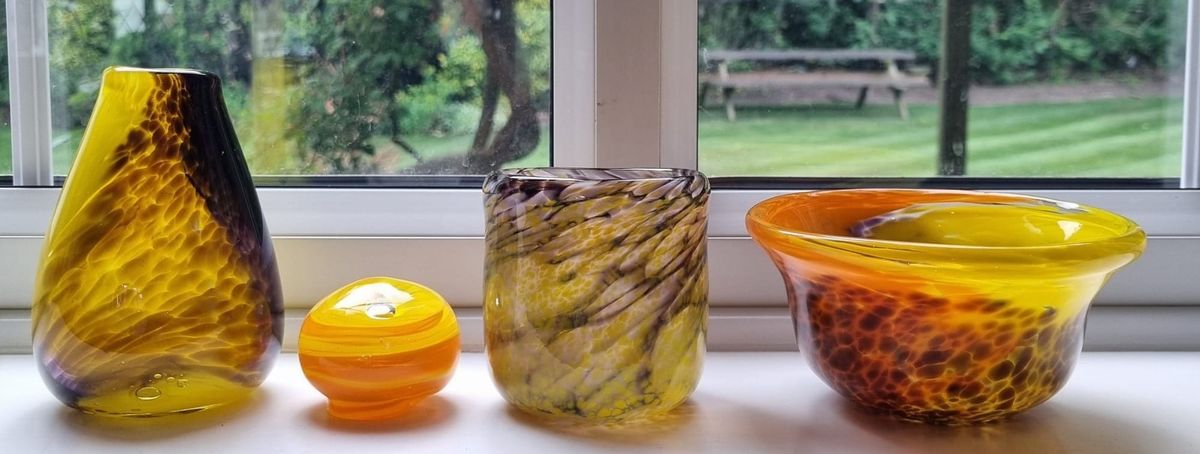
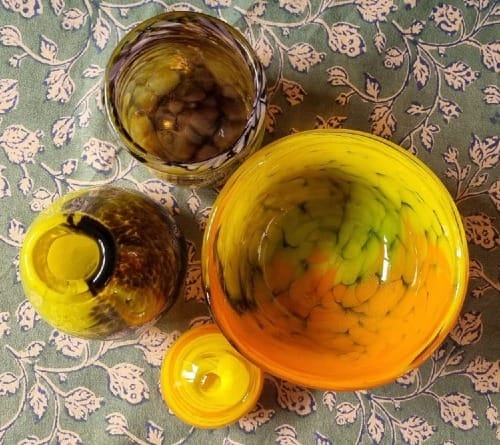
Half a day spent with Sam yielded a load of new information in my head, and four incredible hand made pieces of glassware. I started off with a simple bulb as a paperweight, graduating with a vase. I had long ago decided that my office would have a purple + mustard colour theme (see previous posts for that makeover!) so I went all in with those for my creations.
Handling glass which was over 1000 degrees centigrade was a surreal experience.
To begin, Sam led me to the furnace with a long, hollow steel rod in hand. I slowly poked the rod through the door of the furnace until I could see its reflection in the pool of glass, then gently submerged its tip and started rotating. This lifted some of the rather viscous liquid out of the pool onto my tool. Rotating continuously to stop gravity from pulling the molten material downward, I removed the rod from the furnace and dipped the dynamic ball of glass into a bowl filled with yellow glass pellets, with the intention of adding some streaks of colour. Back in the furnace (still rotating it) to melt the pellets, then a quick and careful walk to the work bench. Here, I placed the rod across the arms of the bench. Sam helped me roll the rod back and forth while I took one of the wooden spoon-like tools from the filled bucket to ease the glass ball away from the tip of the rod so I could later cut it off easily. The water on the wood kept it from burning.
Once the glass had cooled slightly, I blew air through the tube. The molten glass expanded like a stubborn balloon. Back to the bench. This time, I used some very sophisticated equipment — a wet, folded newspaper — cradled in my hand to carefully shape the bulb as it rotated. Another couple of steps of heating to form an opening for the cup I had in mind. To separate the cup from the rod, I used what looked like a giant pair of tweezers, its arms like scissor blades, to pinch a groove at the end of the rod. With a file, I performed a sawing action all around this groove. Once the glass had cooled further (it was still at many hundreds of degrees), Sam gave the rod a sharp tap. Having been weakened at the line of the groove with the file, my cup-to-be popped off the rod.
Four more books, and a podcast.
Here are some updates from the Women's Prize!

 Hana Sandhu
Above is a link for my appearance on the Bookshelfie podcast. I selected five books that shaped me in some way, listen in!
And here are four more books from the Non Fiction longlist:
The Finest Hotel in Kabul
The highly respected BBC Journalist Lyse Doucet shares a deep, insightful and sensitive perspective of the last few decades of life and politics in Afghanistan. Given the overwhelming amount of change and violence the people have faced, she does an incredible job of looking at this through the eyes of people centred at the 'Inter-con' hotel in Kabul.
Don't Let it Break you, Honey
Much more than a memoir, Jenny Evans shares the horrific circumstances which lead her to training as a journalist, then being a key player in exposing the phone hacking scandal. A story of real tenacity, the extent of corruption through the media and police was breath-taking.
With The Law on our Side
As a regular consumer of television legal dramas, reading about some real life law and systems was much needed. Lady Hale takes us on a tour of the courts in the UK, with dozens of fascinating cases illustrating how the British legal system works, and doesn't work, for us.
Hotel Exile
A unique World War 2 book written from the perspective of France. Jane Rogoyska explores the people that occupy a hotel in Paris through different phases of the war and beyond. Given the state of the world today, it's a stark reminder of what happens when complacency and hate take over.
Until next time!